
Leave this siteEsc ×2Skip to content
FIRE · Financial Resilience

Training Pills

The FIRE Training Pills are six short lessons on everyday money skills. Each one has a short video, an infographic, a 60-second clip, a social carousel, a one-page handout and a quiz. Use them in a workshop, on your own or on social media.

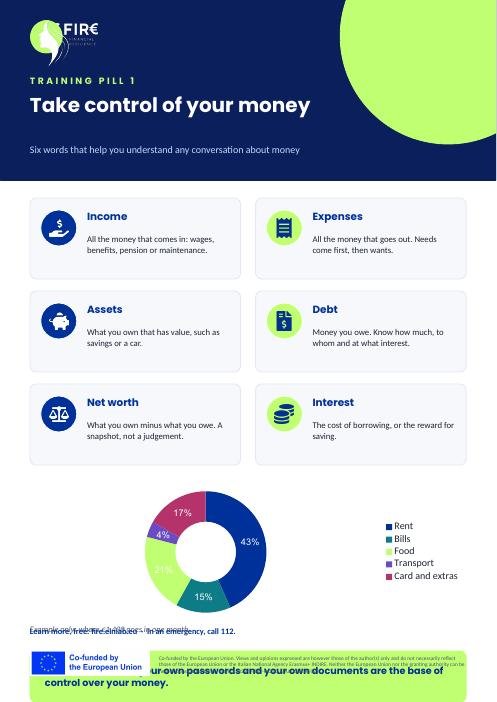
Infographic: Take control of your money

The video of this Pill is not online yet. The infographic and the handout are ready to use.

Pill 1 · 5 min

Understanding and taking control of your finances

In this Pill

  • Know six basic money words, from income to interest
  • See why money in your own name, with your own access, gives you control
  • Take a first picture of your money: what comes in and what goes out

Mini quiz

Which statement about financial independence is true?
  1. It needs a high salary
  2. It is about access, knowledge and control ✓
  3. It means never borrowing money
  4. It is only for women without a partner

Independence is not about how much you have. It is about reaching your money, knowing your numbers and making your own choices.

What is net worth?
  1. Your monthly salary
  2. What you own minus what you owe ✓
  3. The money in your wallet
  4. The interest on a loan

Net worth is assets minus debts. It can be below zero. That is useful information, not a judgement.

Why is a bank account in your own name important?
  1. Banks give lower prices
  2. Only you can reach and manage the money ✓
  3. You never need a budget
  4. It hides money from tax

If someone else controls your access, they control your money. Your own account, with your own login, keeps it in your hands.

Go further

Infographic: Make a budget that works for you

The video of this Pill is not online yet. The infographic and the handout are ready to use.

Pill 2 · 5 min

Budgeting for financial stability

In this Pill

  • See a budget as a plan that puts you in charge, not a punishment
  • Compare three methods: 50/30/20, zero-based and envelopes
  • Build a simple budget in four steps and check it every week

Mini quiz

With the 50/30/20 rule, what is the 20% for?
  1. Rent and food
  2. Eating out
  3. Savings or paying off debt ✓
  4. Gifts

In 50/30/20, half goes to needs, 30% to wants and 20% to savings or paying off debt.

Nadia's budget goes wrong one month. What is the best next step?
  1. Give up budgeting
  2. Adjust the plan and keep going ✓
  3. Borrow to cover her wants
  4. Stop checking her balance

A budget is a tool, not a test. Real life changes, so you adjust the plan and carry on.

Which of these is usually a need?
  1. A streaming subscription
  2. Rent ✓
  3. Eating out
  4. A new phone upgrade

Needs keep life running: housing, energy, food, medicine, transport and childcare.

Go further

Infographic: Build your financial safety net

The video of this Pill is not online yet. The infographic and the handout are ready to use.

Pill 3 · 4 min

Protecting your savings and building a financial safety net

In this Pill

  • Understand what an emergency fund is and why it protects you
  • Start saving small amounts with habits that work in hard months too
  • Keep your savings separate, in your own name and safe from others

Mini quiz

What is an emergency fund for?
  1. Holidays and treats
  2. Unexpected costs and crises ✓
  3. Wants each month
  4. Lending to family

An emergency fund covers surprises, so a crisis does not push you into debt or dependence.

What does 'pay yourself first' mean?
  1. Buy something nice on payday
  2. Save a little as soon as income arrives ✓
  3. Pay your bills late
  4. Keep all your money in cash

Saving on payday, before you spend, makes the habit easy and steady.

Where is the safest place for your savings?
  1. A joint account someone else controls
  2. A separate account in your own name ✓
  3. With your partner
  4. The same account as your bills

Savings in your own name, separate from spending, are easier to protect and harder to use by accident.

Go further

Infographic: Take back control of debt

The video of this Pill is not online yet. The infographic and the handout are ready to use.

Pill 4 · 5 min

Managing debt and financial recovery

In this Pill

  • Make a clear list of your debts and pay the most urgent ones first
  • Choose a repayment method and ask lenders for a payment plan
  • Know that coerced debt can often be challenged, with the right advice

Mini quiz

Which bills usually come first in a debt plan?
  1. Store cards
  2. Rent and energy ✓
  3. Subscriptions
  4. Loans from friends

Bills that protect your home and essential services come first, because missing them can have serious effects.

Your ex-partner took out a loan in your name without your free choice. What is a good first step?
  1. Pay it quietly
  2. Ignore all letters
  3. Get debt or legal advice before you pay ✓
  4. Take a new loan to pay it

Coerced debt can often be challenged. Advice, often free, helps you check your options before you pay or sign anything.

What does 'highest interest first' mean?
  1. Pay extra on the debt that costs most ✓
  2. Pay the newest debt first
  3. Pay only the biggest lender
  4. Pay all debts the same amount

You pay extra on the debt with the highest interest rate, so you pay less in total. Keep paying the minimum on the others.

Go further

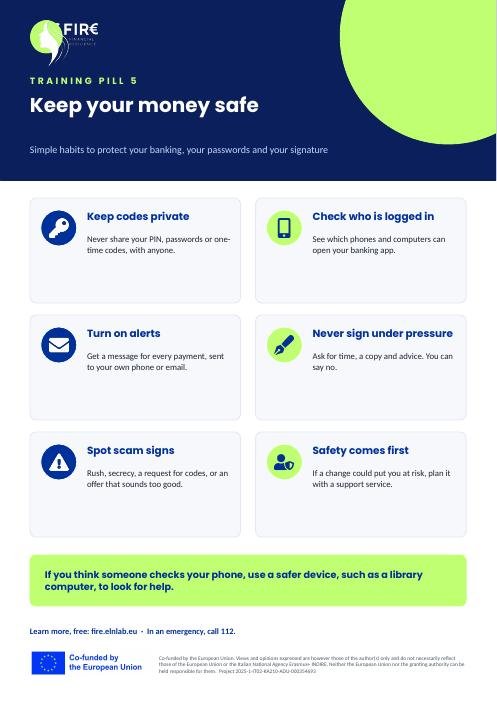
Infographic: Keep your money safe

The video of this Pill is not online yet. The infographic and the handout are ready to use.

Pill 5 · 5 min

Safe financial practices

In this Pill

  • Keep your banking app, PIN, passwords and codes private and safe
  • Spot signs that someone else controls your money or your phone
  • Never sign under pressure, and recognise common scam tricks

Mini quiz

Your partner says: 'If you love me, you give me your banking password.' What is true?
  1. Couples must share passwords
  2. Your passwords are private; sharing is never a duty ✓
  3. It is fine if he only looks
  4. You must also give him your PIN

Love never requires giving up control of your money. Pressure to share your access is a warning sign.

Someone gives you a loan form and says: 'Sign now, there is no time to read it.' What can you do?
  1. Sign to avoid a fight
  2. Ask for time, a copy and advice ✓
  3. Sign without reading
  4. Sign a blank page instead

You have the right to read, take time and get advice. Signing under pressure can leave you with debt you did not choose.

Which message is most likely a scam?
  1. A monthly statement in your app
  2. A text that urgently asks for your PIN ✓
  3. A letter with your new card
  4. A receipt after a payment

Rush plus a request for your PIN or codes is a classic scam sign. A real bank does not ask for your PIN.

Go further

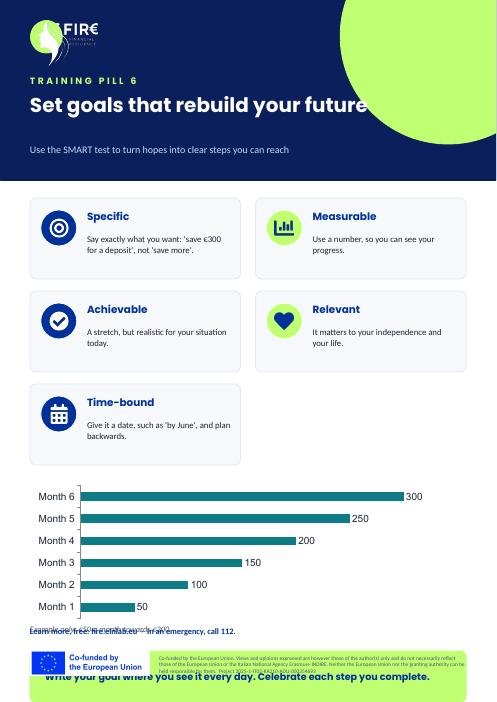
Infographic: Set goals that rebuild your future

The video of this Pill is not online yet. The infographic and the handout are ready to use.

Pill 6 · 4 min

Setting financial goals to rebuild your future

In this Pill

  • Turn a vague wish into a SMART goal you can act on and measure
  • Break a big goal into small monthly steps with dates
  • Balance quick wins with long-term security, like a pension in your name

Mini quiz

Which goal is SMART?
  1. Save more money
  2. Be better with money one day
  3. Save €300 for a deposit by June ✓
  4. Never spend money on treats

It is specific, has a number and a date, and you can check your progress every month.

Your goal is €300 in six months. How much is that each month?
  1. €30
  2. €50 ✓
  3. €60
  4. €100

€300 divided by six months is €50 a month. Small amounts make a big goal easier to reach.

You miss your savings target one month. What is the best response?
  1. Give up the goal
  2. Review and adjust the plan ✓
  3. Borrow to catch up
  4. Stop looking at your progress

Setbacks are normal. Review the plan, adjust the steps and keep the goal. Progress is rarely a straight line.

Go further